
Jeff CarlisleDec 26, 2025, 10:58 AM ET
- Jeff Carlisle covers MLS and the U.S. national team for ESPN FC.
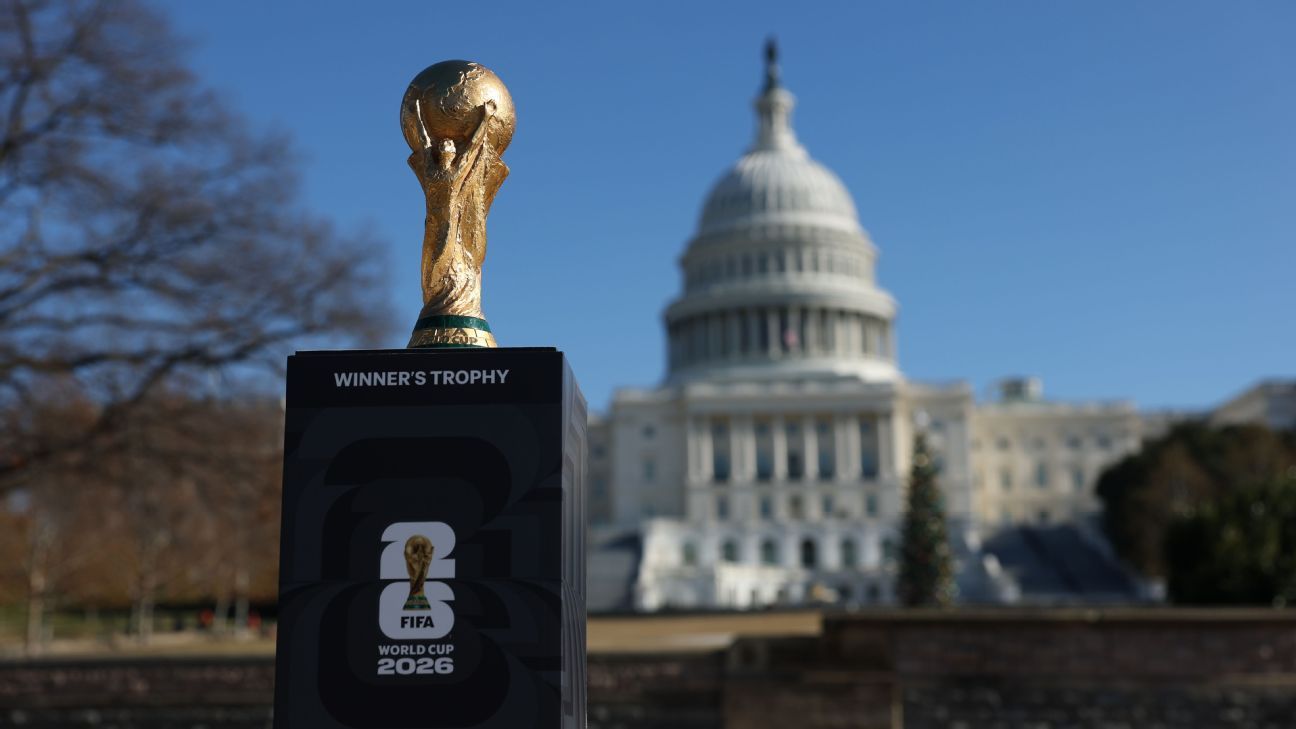
For the U.S. Soccer Federation (USSF), there are myriad presumed benefits for hosting a FIFA World Cup. There is the attention that the event will bring to the sport of soccer, driving interest not only in the U.S. men's national team, but trickling beyond that to the nation's clubs all the way down to the youth team level, where the hope is that children will be inspired to participate at increasing levels.
Yet for the USSF, there is also a more practical benefit, namely the $100 million that it expects to receive from FIFA.
Multiple sources have told ESPN that as part of the agreement that the host countries struck with FIFA for hosting the 2026 World Cup, the federations of Canada, Mexico and the U.S. expect to receive 1% of the tournament's gross revenues. This amount will be split across the three countries. With tournament revenues forecasted to reach $13 billion, along with the fact that the U.S. is hosting 75% of the matches, the expectation of the USSF is that it will receive $100 million.
But more money leads to more questions. For one, how does the financial haul in 2026 compare to the last time the USSF hosted the World Cup back in 1994? And, more importantly, what does the USSF plan to do with that additional windfall?
'It's not make-or-break anymore'
Suffice to say, 1994 wasn't just a different world, but a different World Cup. There was huge skepticism that the USSF could pull off a successful tournament, and not just from people outside the country. The USSF itself was so concerned about the financial risks involved that it organized the World Cup via local committees, which insulated it from any monetary downside. Ticketing revenue was the primary income stream, with any surplus going to a foundation set up after the tournament.
"I guess I was a cockeyed optimist," then-USSF president Alan Rothenberg said. "The federation thought [the World Cup] was going to be a loser, which is why they set up the separate entity and why they agreed to let any surplus go to the foundation because they didn't expect a surplus.
"I guess I should have been a little bit more analytical on the likelihood of success, but I knew how great the World Cup is. I knew that the United States loves a big event, and so if we could make sure that this was perceived as a big event, it would get the attention of people over and above just the core soccer fans."
The 1994 World Cup exceeded all expectations, setting attendance records (both total and per-game average) for the FIFA tournament that stands to this day, but is expected to be broken during the 2026 edition given the expansion to 48 teams. Keep in mind, this 1994 record was set in a 24-team tournament and not even expansion to 32 teams, which started in 1998, was enough to break it.
According to former USSF president Sunil Gulati, who also served as the executive vice president of the 1994 World Cup organizing committee, the tournament brought in a surplus of around $51 million, $5 million of which was loaned to MLS as seed money to get it up and running. Including interest, the amount eventually turned over to the U.S. Soccer Foundation was closer to $60 million.
At first glance, it might appear that the USSF will make more money from the 2026 edition, but when adjusted for inflation, $60 million in 1994 is worth $131 million today. It's worth noting that the organization of the World Cup is very different this time around.
For 2026, FIFA has implemented what Gulati calls "the UEFA model," one championed by FIFA president -- and former UEFA general secretary -- Gianni Infantino. As was the case for the 2018 and 2022 World Cups, the organization is centralized within FIFA, eschewing a local organizing committee in favor of dealing with the venue cities directly. That allows FIFA to keep more of tournament's revenues for itself, though it has created some financial issues for the venue cities, and the structure directs money to FIFA that would be reinvested in the U.S. instead. This is similar to what happened when the U.S. hosted multiple editions of the Copa America. In 2016 there was a local organizing committee, but it was more centralized by CONMEBOL in 2024.
The $100 million the USSF is expecting to gain is still a significant chunk of change, but as Gulati put it, "It's not make-or-break money anymore [for the USSF]. What is make-or-break is the ability to take the sport to a higher level."
'The most played sport in the country'
USSF CEO JT Batson isn't content to just take the sport to a higher level. His ambition is to make soccer the "most played sport in the country."
According to the National Sporting Goods Association, soccer has 15.8 million participants, trailing both basketball (23.9 million) and golf (21.6 million). To achieve its goal, the USSF has created a foundation, called Soccer Forward, which, with the help of the funds obtained via the 2026 World Cup, is hoping to make the game more accessible. Pay-to-play has long been a scourge of the U.S. soccer development system, with children from disadvantaged backgrounds often priced out of the sport.
Batson aims to address that.
"What is exciting about the $100 million is that we'll be able to use it for very targeted investments in participation and growing-the-game types of initiatives," Batson said. "And these are things that don't have natural business models. And so being able to use philanthropic funds, which of course we've grown a lot of those as well as legacy funds from the World Cup, that allows us to really accelerate our investment in that.
"Ultimately our goal is to have a very large endowment that is focused specifically on participation, access, growth of the game. And this $100 million will be an awesome jumpstart to that."
What Batson is proposing is a massive undertaking. The U.S. has more than 340 million people, spread across four time zones. Getting various stakeholders to buy in to the extent necessary is difficult in the best of times, and the competition from other sports remains intense. For that reason, the USSF's plan invites some skepticism, both in terms of determining the bar for success, as well as what a national federation can achieve.
"[Growing soccer] is very much pushing at an open door," said Stefan Szymanski, author of the book "Soccernomics" and a professor of sport management at the University of Michigan. "The sport is growing in popularity. A lot of parents don't want their kids to play [American] football anymore. They'd much rather play soccer. It's kind of shrewd for the federation to say 'oh, we're promoting soccer' because soccer is going to grow."
Szymanski added, "I think we ought to be realistic here though about the limits of this. To create a level playing field, if I may use that expression, one really would need thousands and thousands of fields across the country, and the amount of money that U.S. Soccer is going to put in is going to be a drop in the ocean in relation to that."
Batson is aware that the USSF's impact will be limited, both in terms of programming and finances. Reaching his goal will take far more investment than the $100 million from the World Cup, more than the $50 million in fundraising it achieved for the fiscal period ending on March 31, 2025. That is why he is attempting to build a coalition of stakeholders -- one that includes pro leagues, youth clubs, school districts, as well as state and local governments -- that can work together to not only draw kids and families into the sport, but keep them there. Much of this falls under the umbrella of the USSF's "Soccer Everywhere For Everyone" initiative, as well as the federation's Pathway Strategy from recreational to competitive to pre-professional to professional.
"A lot of people play soccer in this country. That also means if you want to make it easier, more affordable and more accessible, that ultimately is hundreds of millions of dollars a year that you need to be able to flow back to the ecosystem," Batson said. "And so U.S. Soccer will be able to play a role in that, but also, we need local governments. We need school districts. We need local businesses and community organizations leaning in.
"The heart of the Soccer Forward strategy is focused on how are we bringing all these people together to be able to make it to where soccer is much cheaper, much more accessible, and ultimately more fun so that millions and millions more people can go play it."
An unlikely inspiration to coalition building
Batson said the USSF has studied anti-smoking and anti-drunk driving initiatives to get a sense of how the USSF's programs can be impactful at every level of the soccer ecosystem. He looked at what the national organizations were, as well as local activations. What were the coalitions at the local and national level that led to change in behavior -- or in soccer's case, interest -- on a massive scale?
"We did a whole lot of research on that before we designed the approach to Soccer Forward, because we believed that to deliver soccer at scale, at the sort of price point to where everyone can do it, it's going to take everybody working together on that," Batson said. "And so far, people are really excited. Everyone's leaning in, good early progress, but this is a huge-scale effort, and that's also what makes it fun."
The connection with anti-drunk driving initiatives seems specious at first glance, but Stacey D. Stewart, CEO of Mothers Against Drunk Driving (MADD), sees some similarities. In her experience, having repeated, consistent messaging is critical to growing support and awareness. Finding a shared purpose is critical, and patience will be needed as well. MADD has been in existence for 45 years, and is still going strong.
For Stewart, the biggest key of all is storytelling. MADD got its start in 1980 when Candace Lightner's daughter Cari was killed by a drunken driver as she walked to a church carnival. That story of loss resonated across the country. Obviously, Batson and the rest of the USSF are telling a different type of story, but one where soccer can be "a force for good," as Batson said.
"I think the storytelling is huge because storytelling is so compelling across social media," Stewart said. She added, "It's the power of stories, individual stories, that creates that spark where people begin to see themselves in other people's stories, and that connection starts to happen."
One current story the USSF can tell relates to its Soccer at Schools initiative. It is made up of a toolkit that aims to provide soccer advocates the ability to start soccer programs at schools, and address issues like funding, connecting with schools, assessing facilities, as well as activities for participants.
The Rosati Leadership Academy in Lewiston, Maine, started an after-school indoor soccer program at Connors Elementary School that operates five days a week, a lifeline to an economically disadvantaged community. Beyond soccer, the program emphasized social and emotional learning for the 200 students per year that took part, with student behavior and performance both showing improvement.
It might feel like a drop in the bucket, but it speaks to the kinds of programs the USSF is looking to replicate as they cast a wider net to get children involved in the sport. A U.S. Soccer spokesperson said that the USSF would announce additional school programs in the spring, with a rollout in the fall.
1:51
Kane: Only winning the World Cup would satisfy England
Harry Kane speaks about England's hopes of winning the World Cup and the pressure of being one of the favourites.
Facilities are part of the puzzle as well. Colder climates will require indoor fields, while urban environments require hard-top mini-pitches given that green space is often at a premium. Then there is the insatiable appetite for full-sized fields. Batson indicated that the USSF has armed soccer advocates with information and data to convince local politicians that sports fields are a good investment.
But such projects require plenty of heavy lifting.
Beverly Smith is the vice president for sports and youth development with Local Initiatives and Support Corporation, a nonprofit that helps facilitate housing and economic development in underserved communities. Smith's focus is on building sports fields in those locales, and is currently working with the Arthur M. Blank Foundation to build 100 mini-pitches across the state of Georgia. (Note: Smith has also teamed with ESPN to build a mini-pitch at East Point Station in Atlanta.)
Smith notes that a successful project isn't just about building the facility; there has to be a maintenance plan to ensure its long-term viability. Then there is the coalition building at the local level to ensure success. The USSF said it has agreements with local entities to handle the maintenance aspect, but Smith indicated that the Federation needs to stay connected to these projects.
"For the U.S. Soccer Federation trying to build a coalition around this, it really requires that you have your finger on the pulse of what's happening on the ground and where you want to put this and hear the voices of everybody," Smith said.
Just how deeply involved the USSF will be in such projects remains to be seen. A U.S. Soccer spokesperson told ESPN that there is dedicated staff within Soccer Forward that is focused on these endeavors. The same is true of its success in coalition building. The level of intentionality required seems vast, although the infrastructure provided by youth clubs and state associations is already in place, and will help in the process.
Will the USSF be an active or passive partner? The scope of Batson's vision demands the latter approach. Whether the level of execution follows is to be determined. Either way, the hope is that the USSF can make the $100 million windfall from next summer's World Cup count.