
Ryan S. ClarkFeb 12, 2026, 06:15 PM ET
- Ryan S. Clark is an NHL reporter for ESPN.
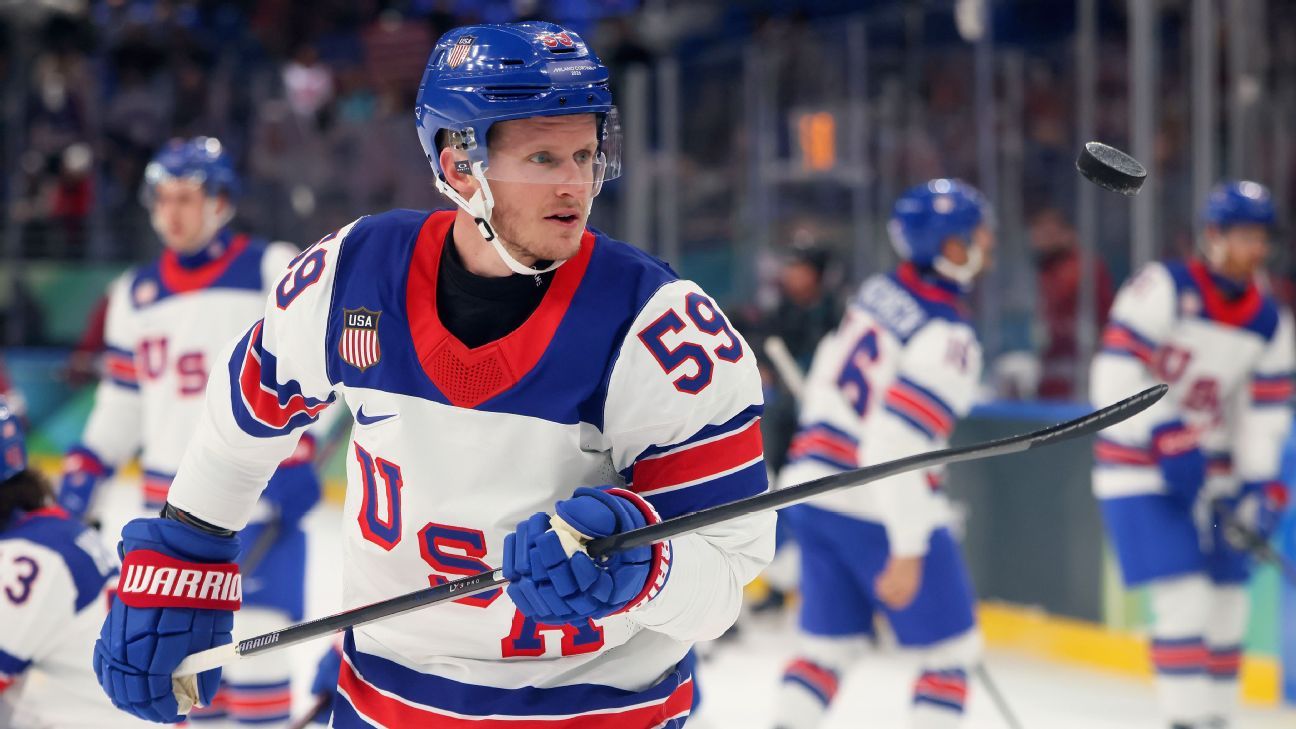
Team USA has won its opening game in the 2026 Olympic men's ice hockey tournament, upending Latvia by a final score of 5-1.
The contest was not without some drama, as the first period included two successful coach's challenges from Latvia that wiped U.S. goals off the board.
After that, however, the ice seemed to tilt the Americans' way, and goals from Tage Thompson, Auston Matthews and a pair from Brock Nelson were the difference.
Here's what we learned in the opener, along with an overall team grade and big questions to ponder prior to Team USA's matchup against Denmark on Saturday.
Takeaway 1: Who did it better, the Hugheses or the Tkachuks?
There are certain players every team must rely on if it's going to win. Team USA is no different, and that's what makes the Hughes and Tkachuk brothers rather crucial.
Let's start with the Hughes brothers. Quinn might be the most important player on the roster. He's a top-pairing defenseman who can be trusted in every situation. That was on display against Latvia, as he finished with a team-high 21:29 in ice time and registered two assists. Jack opened the game on the fourth line and also finished with a pair of assists.
What about the Tkachuks? Physicality was a theme Thursday, and the Tkachuks are at the heart of why it was a factor. But there's so much more to their respective games than being bruising power forwards. It's why they were on the top line alongside Jack Eichel, which created a combination that used size, speed and skill to present numerous issues throughout the game for Latvia. Brady scored the game's opening goal, and Matthew added a pair of assists.
Takeaway 2: Does Mike Sullivan have a decision to make about his lines?
We'll expand on Brock Nelson's individual exploits here shortly, but Nelson's contributions showed how the U.S. got quite a bit from its fourth line. He anchored the line featuring Jack Hughes and J.T. Miller and had two goals (and could have had more).
The younger Hughes brother had a pair of assists. Miller's contributions are a bit more complicated. Miller set up Quinn Hughes for a first-period goal that was one of the two that were disallowed. He was also at the net front for what became a second disallowed goal that was called back for goaltender interference. Miller had the most ice time of the trio, with a little more than 12 minutes, while his linemates each finished with slightly more than 11 minutes.
Will we see some tweaking in the games against Denmark and Germany, or will Sullivan stick with what worked?
Everything coming up BROCK. NELSON. #WinterOlympics pic.twitter.com/yy7xGkXiR0
— NBC Olympics & Paralympics (@NBCOlympics) February 12, 2026Takeaway 3: The fatigue factor
One of the underlying themes from the 4 Nations Face-Off was the pace, especially in the final game between Canada and the U.S.
That pace was a factor in the first four minutes of this game, as part of an approach that saw the U.S. wear down Latvia in numerous ways. Combining that speed with physicality and puck possession eventually made Latvia go from a team that tied the game at 1-1 to a team that struggled to just keep up for the final 40 minutes. There were the penalties. There were the goals that came from those penalties. There were those long shifts that allowed the U.S. to dictate play in a way that helped it score four unanswered goals.
Can the U.S. do that against other teams? It's possible against the other nations with a mix of NHLers and non-NHLers, but what we saw from the Canadians on Thursday indicates that they would be able to keep up.

Player of the game: Brock Nelson, center
There's the two goals he scored. There were also the two goals he almost scored; one off the post, and one disallowed for goalie interference.
Either way, Nelson had both the most memorable and arguably strongest performance of any player for Team USA.
Naturally, the conversation around Nelson's game is going to center around his goal contribution. But there's also a point to be made about how was always in position while being able to use his 6-foot-4 frame to create openings in what was a physical game against Latvia.
Will the U.S. score even more goals against Denmark?
Being the two favorites to capture the gold medal is why there's going to be one eye on Team USA and another on Canada throughout this preliminary round.
Canada struck first with a dominant 5-0 win over Czechia, shifting the focus to the U.S. in its matchup later on Thursday. The answer was a 5-1 win.
Now it's about seeing if Team USA can carry that over into its next game Saturday against Denmark. The Danes were playing at the same time as the U.S. and lost 3-1 to Germany, despite the fact they finished with 38 shots.
Overall team grade: A-
The only real blemish for Team USA in its opening game was the lone goal it allowed because of a net-front scramble. But beyond that, the Americans controlled every aspect of their opening game.
Those disallowed goals along with Latvia's game-tying goal created a bit of a tenuous start. But the four unanswered goals -- and how the U.S. flexed its skill and strength -- made it too hard for Latvia to find an opening.