 1 month ago
44
1 month ago
44
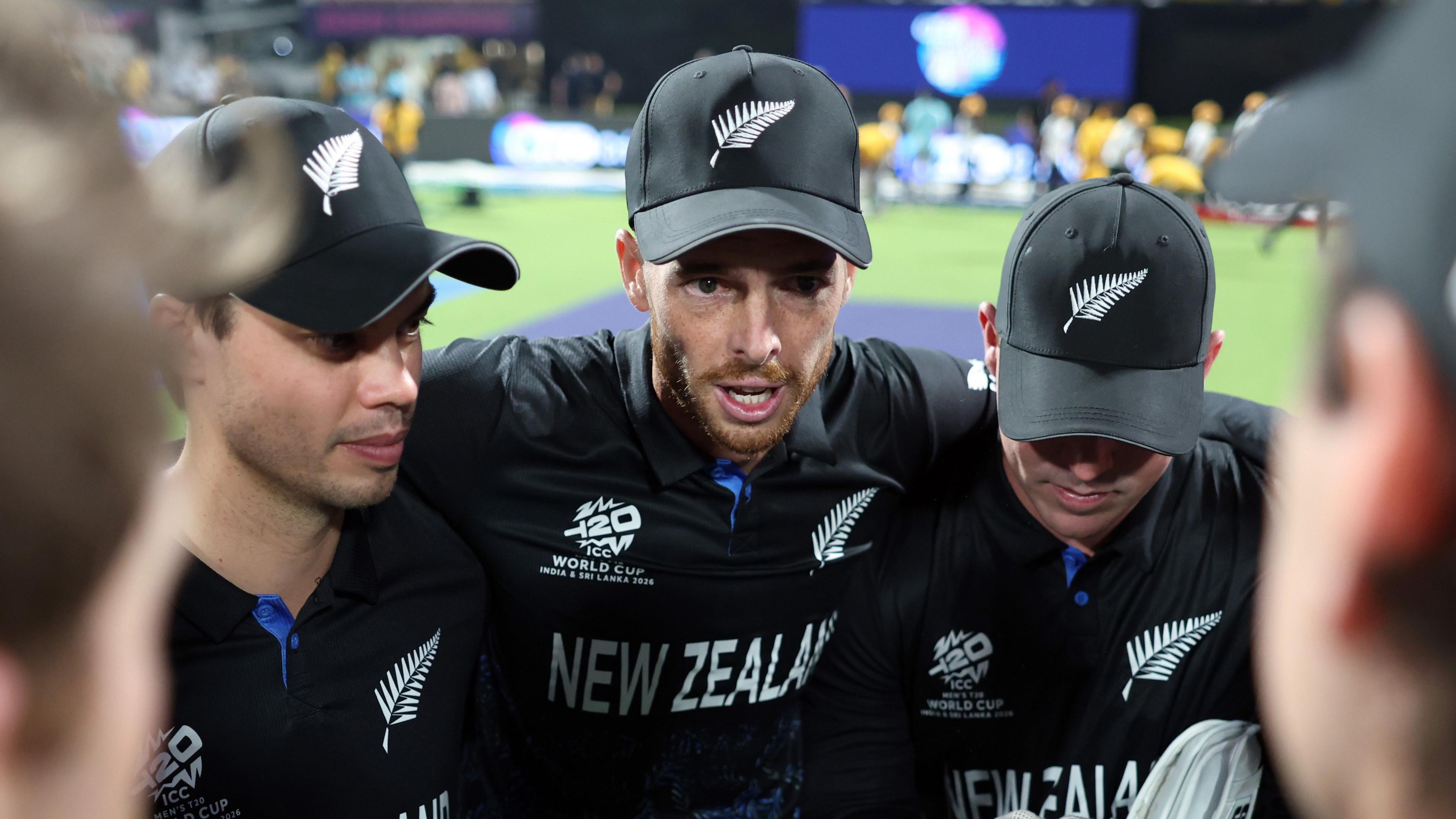 Image source, Getty Images
New Zealand won the ICC KnockOut in 2000 but have never won a men's white-ball World Cup
ByMatthew Henry
BBC Sport journalist in Ahmedabad
New Zealand do not make natural heartbreakers.
They are cricket's nice guys - your second-favourite team.
Brendon McCullum's men thrilled in 2015. You still feel guilty for Kane Williamson's side after that deflection off Ben Stokes' bat four years later at Lord's.
Sunday's T20 World Cup final against India in Ahmedabad will be the Black Caps' fifth white-ball final in the past 11 years.
They lost the meeting with India at the Champions Trophy a year ago and their three World Cup finals before that, always the charming best man rather than the groom.
"I wouldn't mind breaking a few hearts and lifting a trophy for once," said captain Mitchell Santner with a smile at his press conference.
And there will be plenty of hearts to break. A crowd of around 100,000 is expected at the Narendra Modi stadium, plus more than a billion watching at home, with almost all supporting the tournament co-hosts and defending champions.
"We are pretty consistent in these tournaments because we try not to get overawed by the situation or opponents," Santner said.
"We just go there and do our thing and as a unit it's been no different this time."
Santner admitted his side will not be favourites but how can they beat cricket's biggest power in a final in their own back yard?
Santner's men do not have to look far for inspiration.
The venue for this final is the same as the showpiece of the 2023 50-over World Cup, when Australia stunned previously unbeaten India to take the title.
Under the weight of expectation, India were tentative with the bat and dismissed for 240 before Travis Head's century powered Australia to a rapid victory.
"There's obviously a lot of pressure on India to win this World Cup at home," Santner said.
"We can go out there and try and put that added pressure on them and see what happens."
Against Australia, India reached 76-1 inside 10 overs but only 72 runs came between the start of the 11th and the end of the 30th.
The change in format should prevent India being cautious again but New Zealand, who have reached this final despite losing to South Africa and England previously in the competition, must pounce on any sign.
India captain Suryakumar Yadav said he did not feel the need to discuss the 2023 defeat with the team.
"We have been preparing for this stage really well," he said. "It started two years back and the circle has come to the same stadium in that we left in 2023.
"Hopefully we play some good cricket, be courageous in tough situations. That is the simple message to the team."
New Zealand are well aware of the strength of India's batting order. They lost 4-1 in a T20 series before this World Cup, with their hosts scoring more than 200 in three of the five matches. India chased 154 in 10 overs in one of the others.
The semi-final against England on Thursday showed the importance of taking wickets if you are to have any hope of limiting India's run-scoring.
England took one in the powerplay but dropping Samju Samson meant the co-hosts piled up 253-7.
"The only way to slow any team down is wickets at the top and then try to squeeze a few overs in the middle," Santner said.
"If it's going to be flat, it might be like the other night, trying to restrict it near to 220 instead of 250."
Samson brings up 'magnificent' half century against England
The average first-innings score at Ahmedabad in this World Cup has been 189, including South Africa's 187-7 here against India in the co-hosts' only defeat so far.
The final will be played on a 'mixed soil' surface - some red and some black soil - and is expected to be good for batting again.
But taking early wickets has not necessarily been one of New Zealand's strengths in this tournament.
They have taken 10 wickets in the powerplay - five fewer than India. Their bowling strike-rate in that phase only ranks as the 13th-best across the competition.
Helpfully, Samson has scored 56 runs in seven T20 innings against New Zealand.
He averages just 7.5 against Black Caps seamer Matt Henry across all T20s.
Another way New Zealand can attack India is with the off-spin of Cole McConchie and all-rounder Glenn Phillips.
India have struggled against off-spin this competition, averaging just 15.9 and scoring at 7.2 runs per over - their worst record against any bowling type.
They have five left-handers in the top eight, including world number one batter Abhishek Sharma, who has been dismissed by an off-spinner in three of the four innings in which he has faced such bowling so far.
McConchie would not have played at this World Cup but for an injured to Michael Bracewell. He has a strength and conditioning business and previously ran a commercial cleaning business with his father.
But the 34-year-old from Christchurch has bowled eight powerplay balls to left-handers at the World Cup, dismissing South Africa duo Quinton de Kock and Ryan Rickelton while conceding only 13 runs.
He could have a big part to play.
Bank on the Bash Brothers
Conversely, New Zealand must bank on their fearsome opening partnership.
Finn Allen and Tim Seifert, nicknamed the Bash Brothers, have scored 463 runs together in seven innings at this tournament, averaging 77.2, with two century stands.
One of those came in the semi-final against South Africa in Kolkata on Wednesday when Allen scored a 33-ball 100 not out.
Though Seifert played in four of the five matches, Allen only played once in the series against India earlier this year.
He was absent at the Big Bash in Australia, where he helped Perth Scorchers win the title.
His presence should boost the Black Caps' chances.
New Zealand's Allen smashes incredible 33-ball century
Targeting the number one T20 bowler in the world rankings may seem foolish but it might be New Zealand's best chance.
After a solid start to the tournament, India spinner Varun Chakravarthy is struggling.
Since the start of the Super 8s, he has managed only four wickets in four matches at a frightening economy of 11.6 runs per over. In the group stage he took nine wickets, with his economy 5.2.
Suryakumar backed his spinner at his press conference, suggesting there will be no late change from India.
The problems are perhaps explained by Chakravarthy's change in length.
He has dropped shorter since the Super 8s began - pitching the ball 6.1m from the stumps on average compared to 5.7m beforehand - thus taking the stumps out of play.