 1 month ago
51
1 month ago
51
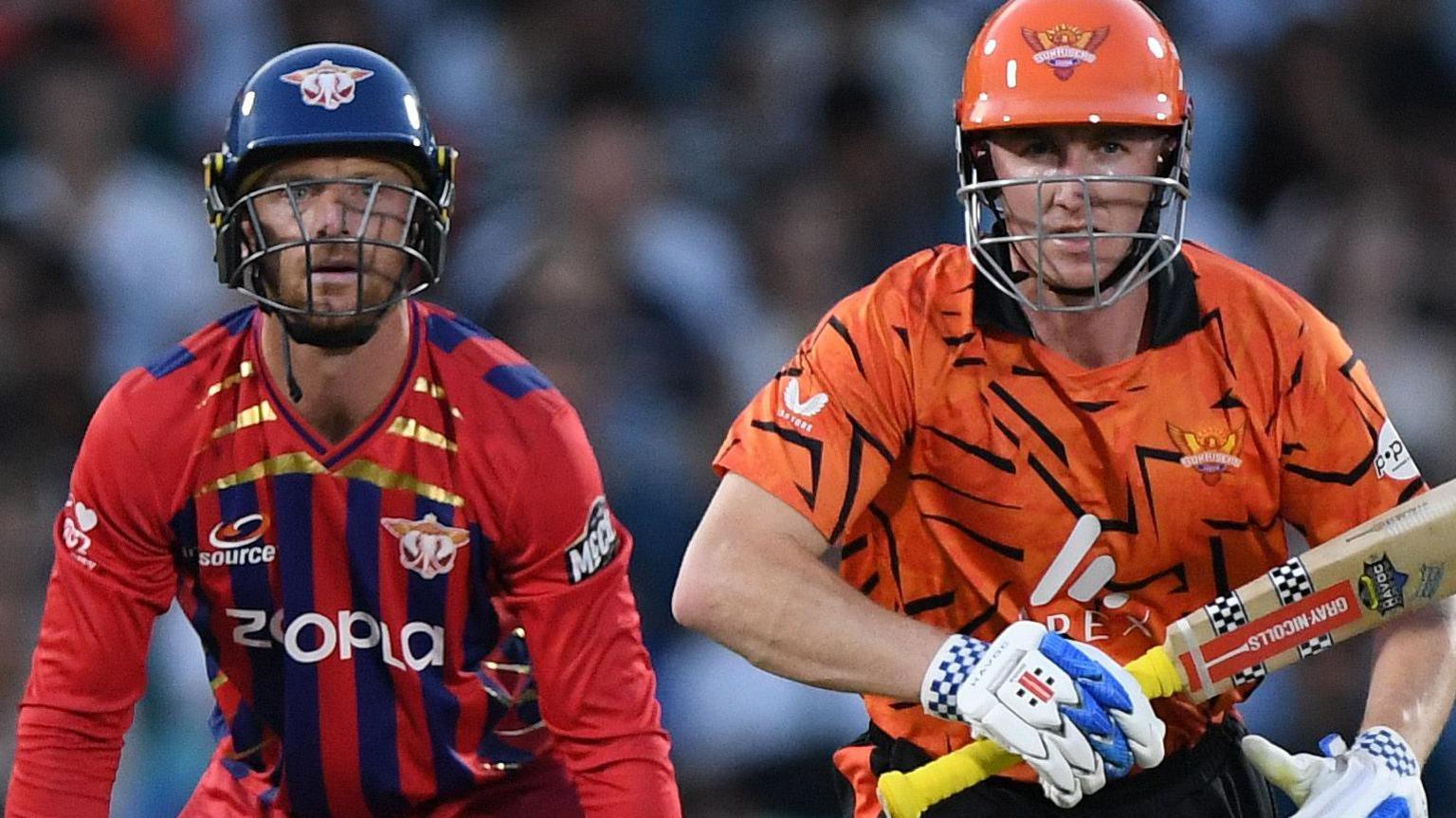 Image source, Getty Images
Manchester Super Giants and Sunrisers Leeds are two of the franchises to have changed their names and kit colours this season
ByHenry Moeran
BBC Sport cricket reporter
The cry echoes around the changing room: "Marching on together!"
Except this isn't Leeds United's players belting out their club anthem, but the Sunrisers Leeds Hundred squad, awkwardly singing a new version.
There are lyric sheets involved, and some players are laughing as if struggling with a task set by a self-proclaimed comedy best man at a wedding.
The video is shared on social media by Sunrisers after a win and soon deleted.
It illustrates a key issue facing The Hundred after its first year since the private investment that has resulted in several rebranded teams - including Sunrisers, who took the place of the Northern Superchargers.
History and tradition are, by their nature, impossible to manufacture.
But creating a clear team identity is a vital part of reaching those all-important new audiences.
What has been the impact of new owners on The Hundred? Has it been positive? And what are the reasons behind some of their changes?
More benefit to bolder changes?
Lancashire chief executive Daniel Gidney - also on the board of the Manchester Super Giants (MSG), who rebranded from the Originals and changed their team logo and colours - says there's no choice but to be bold.
"If you're trying to launch a new brand in a new market, in the UK particularly, in a city that is dominated by football, you've got to go big and loud," Gidney told BBC Sport.
One daring 'brand activation' resulted in almost 30,000 free shirts being given to Super Giants fans.
"To give everybody a free jersey who bought a ticket is extraordinarily different," said Gidney.
"You can't normally do it because a kit manufacturer will go, 'No, no, no. I've got to sell that kit for £60-80.'
"You never get anything for free. It's had a massive impact, much more than I thought."
The decision was made this first year to forego a potentially lower kit deal for the opportunity to build the MSG brand, get fans in the team colours, and then strike a more lucrative supplier deal in years to come.
But how does that benefit Lancashire more broadly? The county's merchandise continues to be sold at Old Trafford on matchdays, while at the moment you won't find MSG products in the club shop.
Gidney says Lancashire were able to "retain effectively 50% merchandise arrangements" with MSG, who they can use as a "bit of a pilot" - possibly bringing some of what they learn into the T20 Blast competition.
Highlights: Walter stars as Super Giants beat Sunrisers in eliminator
Other models have proved effective.
Lord's-based London Spirit kept the blue and black colours of their previous kits but also added red and yellow stripes of Marylebone Cricket Club (MCC).
Their replica shirts cost £55, but Spirit have already exhausted the supply they had earmarked for both 2026 and 2027.
Spirit, the most valuable franchise following a huge £145m investment from a consortium of tech billionaires, have seen their popularity grow among new and established cricket fans - the number of MCC members attending Hundred fixtures doubled from last year to this.
However, overall crowd numbers and ticket sales are marginally down compared to last year - though tournament director Vikram Banerjee is keen to point out the competition has undergone a transformation.
"It's impossible to overstate the scale of operational change the competition has gone through this season, but we're really happy with where we are and what has been delivered this year," he told BBC Sport.
It has been noticeable at certain venues that the loyalty to previous franchises has had a slightly complicated transition.
Oval Invincibles felt like a coherent brand, with their unique mint green colour scheme. Helped by sustained success in winning five of the 10 titles across the men's and women's competitions so far, fans clearly bought into the team.
The team are now MI London, whose blue kit matches the owners' other franchise teams including Mumbai Indians but is very generic. Time will tell if fans feel quite as loyal to that franchise as they did.
Widening cricket's reach despite divisions?
Highlights: Sunrisers secure five-wicket win to reach Hundred final
Regardless of any rebranding this season, there remains a deep divide within cricket over the very existence of The Hundred.
One prominent investor told BBC Sport that while the relationship between their Hundred franchise and the county who hold a stake was excellent, they were surprised by the negativity of the reaction from 'traditional County Championship fans'.
Of course, it's not just about how many are coming through the doors, but who they are.
"The most important thing is that it's brought a completely different and younger demographic into the sport," says Glamorgan chair Mark Rhydderch-Roberts.
He adds: "46% of ticket buyers are new to Sophia Gardens, 30% are female buyers, and 46% are family tickets."
These are the sort of numbers that will have chief executives from Leeds to Lord's purring.
"It's down to my job to try and convert those to come and watch the Blast and ultimately the County Championship," says Lancashire's Gidney. "It's lifting everybody up."
Whether or not that theory holds true might be disputed by fans of those counties who don't host a Hundred franchise, but Rhydderch-Roberts is clear about the impact in Wales.
"The Hundred has given us the chance to really transcend what's a difficult and fairly challenging macroeconomic environment and take us in a different direction," he says.
Aside from fans visiting the ground, perhaps the key metric will be the television audience and future wealth that can potentially be unlocked.
In India, online streaming platform FanCode was previously the only place to watch The Hundred, but this year the tournament is front and centre on JioStar - the same place where fans would watch the Indian Premier League (IPL).
So far this year, modest broadcast audience growth is an encouraging start. And next year negotiations will begin over a new broadcast deal, which the owners will clearly have an eye on.
Some might feel too much focus is given towards the IPL link, with four of the eight Hundred teams owned by group also involved in IPL franchises.
Things certainly look and sound different at the grounds - the booming call of "MSG! MSG! MSG!" at Old Trafford has a very IPL feel to it.
However, ECB chief executive Richard Gould says India isn't the be-all and end-all.
"The Indian market is marginal to us when you look at the relative broadcast values from overseas," he says.
"This is a UK competition, largely for a UK fanbase and a UK market, and that will always be our strength and our focus."
Gould adds that while The Hundred would "love" to be like football's Premier League where "50% of your revenue comes from overseas", there must also be an awareness of where cricket sits in terms of global appeal.
He says: "We're at the start of that journey. We need to make sure that we focus on what's right for our market."
A future move to T20 competition?
Through it all, there is the ongoing question as to whether The Hundred will one day become another T20 league.
Banerjee says for the time being the tournament's identity is built around its unique 100-ball format.
"What's really important for any sporting tournament is the strength of foundations within its home country," he says.
"Whether you're the NFL, the Premier League, the IPL, the strength in their home territory is important."
And Gidney says shifting to T20 would not be something investors would necessarily even want.
"Everybody sees the uniqueness of The Hundred, and that's one of the big appeals to broadcasters," he adds.
"If we become a T20, I don't think we can say that. The Hundred gives the UK a real opportunity to say, 'Do you know what? In certain elements we can be as good as, if not better than, the IPL.'"
The Hundred will remain controversial. It'll never be for everyone, but then is any cricket format?
What can't be denied is the tournament has generated vast revenue and given English cricket a chance to reach audiences, both local and globally, that might not have been accessible without this radical change.
What that change will look like in 10 years' time remains to be seen.
Who knows if the English game will be marching on together as hoped by those that have staked so much on this direction?