 3 weeks ago
17
3 weeks ago
17
More than five decades ago, a group of rugby players formed a team that brought a new spirit to the game and inspired generations of black players.
Reading West Indians RUFC brought flair, speed and a new kind of rugby to Berkshire, with the club becoming a home for players of African and Caribbean descent.
Set up by Redingensians Joe Bell and Kenmore Hinds in the 1970s, the club became a launchpad for national talent.
Radio Berkshire's Lorin Bozkurt returned with Bell and former player and teammate Wayne Foncette to the ground on Old Bath Road, Sonning, where it all began.
In the early 1970s, the men played local Sunday rugby while undertaking apprenticeships at Adwest in Reading, said Bell.
"The fire brigade had a side but they were getting beat all the time and they didn't have enough fast players so they decided to invite us to to play with them and that's when we decided to start our own club," he said.
But they faced "significant challenges" thanks to a lack of players.
"It was very difficult," said Bell. "We'd drive down on the Oxford Road and I always used to have about two pairs of boots in my car and some shorts, just in case I see another black person and would say: 'Have you played rugby? Would you like to? Get in the car'.
"We used to do things like that."
From this small beginning, Reading West Indians RUFC became a formal member of the Rugby Football Union by the 1975/76 season and went on a successful Caribbean tour in 1989, with a touring party of more than 60 members and matches in Trinidad and Barbados.
Foncette joined Reading West Indians RUFC in the early 1980s after crossing over from football.
"I used to, at the beginning, play football on a Saturday, football on a Sunday morning, stay in my kit and then come and play rugby in the afternoon," he said.
"That's how a lot of players joined at the beginning, they would come along, watch and then go, 'you guys are having fun'."
By the early '80s, people were "travelling from everywhere" to play with them, said Foncette.
"We were then known as players who would come from Harlequins or Saracens or Bath so we ended up playing with that calibre of players, which ultimately ended up with a lot of Nigerian boys then getting involved.
"So from out of that, in the early '90s, London Nigerians were established."

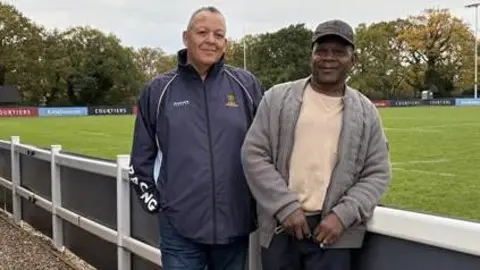
Foncette (left) and Bell revisit what was once the Reading West Indians RUFC's ground
A standout moment for Foncette came when Reading West Indians were invited to play against London Maories in a warm-up game when New Zealand were playing Australia.
"They'd heard about our style and thought it'd be great," he said.
"There were about 2,000 or 3,000 people there at the game. We both went hell for leather because we're all big boys and we're all playing open rugby.
"They wouldn't kick it, we wouldn't kick it. I think we won the game something like 43-38.
"But most enjoyable was the fact that when the whistle blew at the end of the game - bear in mind we were the warm-up act - the crowd stood up on their feet and gave us, both teams, a standing ovation."
For Bell, what made Sunday rugby so special was the freedom to "express themselves".
"If you played on a Saturday, especially being a West Indian, we were quite restricted in what we could do on a pitch," he said.
"It was all regimented and we had talent but we couldn't express that because they wanted to put us in a category all the time.
"So when we started playing on Sunday, everyone could express themselves. They could be who they want to be. They could show off their talent with someone saying, 'you can't do this, you can't do that'."
Sunday rugby, says Bells, "is and was a great feeling".